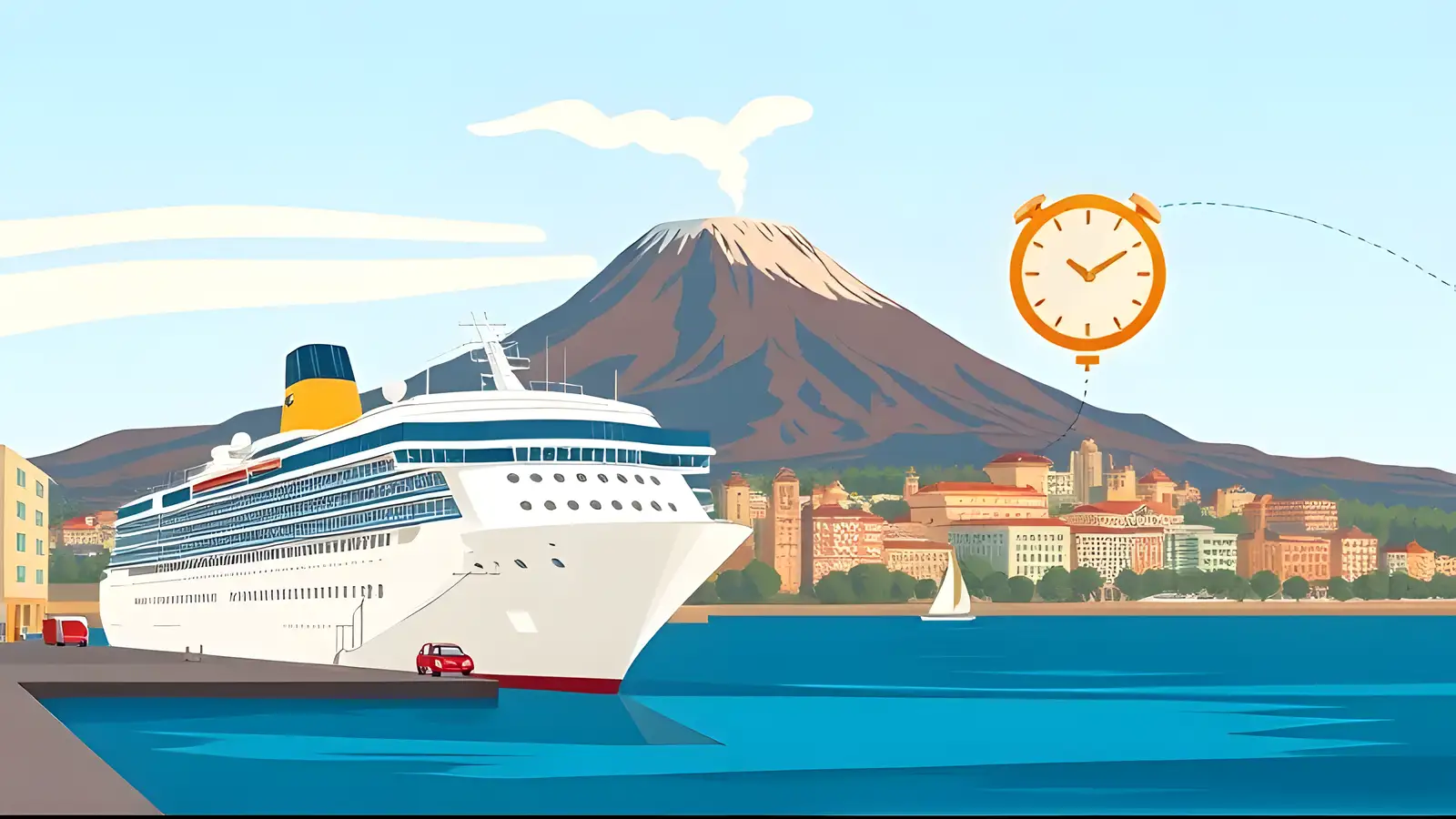
Does the port call leave enough time?
Start with the ship’s confirmed disembarkation and all-aboard times, including time to leave and re-enter the terminal. Compare them with the excursion calendar, both road journeys, parking and possible delays. A long enough port call may allow an Etna visit, but a general article cannot confirm that your specific schedule fits.
Choose the exact mountain destination
From Catania, calculate the drive to the meeting point of the programme you want. Rifugio Sapienza is the southern cable-car base around 1,900 m; Piano Provenzana is the northern base around 1,800 m. The northern summit trek is not reached by the southern cable car. A route to a generic “Etna” marker is not a reliable journey estimate.
Read the provider’s actual conditions
Our three private excursions meet on the mountain, which you reach independently in your rental car. We do not provide port pickup or a return-to-ship guarantee. A cruise-line excursion or another operator’s package has its own written transport and return terms; those terms do not apply to our guiding service. Book each service only after confirming that its schedule fits.
Private guide, mountain transport and cost
Our southern Cable Car & 4x4 programme lasts about three hours, including roughly 90 minutes walking around 2,900 m when allowed. It costs €300 per private group up to six plus €82 per person for the listed mountain transport. Summit Craters from the north lasts about five hours including 4x4, from age 12, and costs €500 per group up to six plus €50 per person. Neither fee includes port transport. The cable-car operator’s standard product and our private guide fee are distinct services.
Access changes and the return margin
Current restrictions, weather and route conditions determine what can proceed; no ticket or guide overrides a closure. If conditions prevent our booked route, choose a practicable alternative, another date or a full refund. This does not cover a promised ship connection. If the planned return leaves insufficient margin, choose another activity or date rather than relying on a guaranteed drive time.
Protezione Civile — Etna · Funivia dell’Etna
Etna from a Catania cruise — quick answers
Can an Etna excursion fit a cruise stop?
Compare the ship’s confirmed times with the chosen tour calendar, both road journeys and a realistic margin. There is no universal cruise schedule that fits every excursion.
Does your tour include port transport?
No. Our tours meet on the mountain, reached independently in your rental car. A third-party transfer or cruise package has separate terms.
Are mountain transport tickets included in the guide fee?
No. The private guide fee is per group up to six; cable car or 4x4 supplements, where required, are per person and listed on the tour page.
Do you guarantee return before all-aboard?
No. Verify the ship’s deadline and allow for delays. If the timing leaves insufficient margin, choose another activity or date.
Compare the three private excursions and their actual requirements.